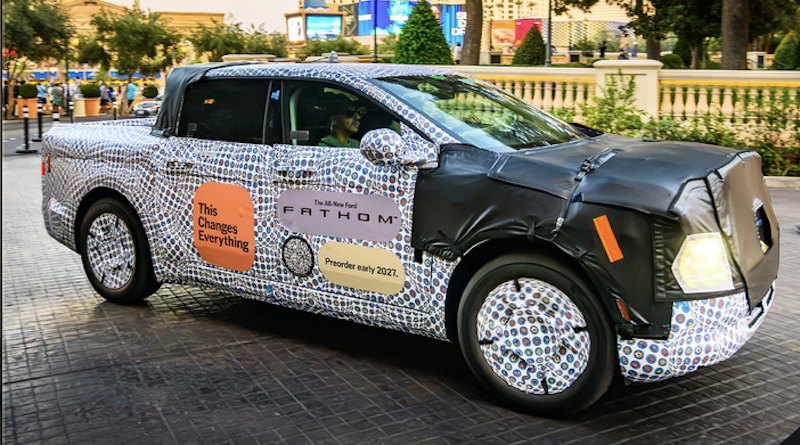
The Ford Motor Company is still disguising the soon-to-arrive Fathom electric pickup truck under a layer of camouflage, but the iconic automaker is more than happy to share what’s going on inside. In the latest news drop, Ford wants everyone to know that you don’t need an expensive inverter to convert the truck into a mobile, zero emission generating station for your home.
📌 The Core Development
The idea of using an EV battery to power household appliances seemed pretty futuristic back in the early 2010’s, but nowadays the technology is commonplace. The key is bidirectional charging technology, which enables an EV battery to discharge electricity as well as receive it from a charging station.
One obvious use is backup emergency power, where EV batteries have the advantage of quiet, pollution-free running — unlike gas or diesel generators. In case of a prolonged power outage, drivers can travel outside of the blackout area, charge up, and return with a fully charged battery to keep the lights on at home.
🔍 Background & Sector Context
EV batteries can also help ratepayers avoid higher peak demand electricity rates. Households with home EV charging stations can time their charging sessions to take advantage of utility discounts for off-peak use, and discharge their battery to avoid high rates during peak periods.
The sticky wicket, of course, is cost. Generally speaking, home EV charging stations are not free, and neither is the inverter needed to convert the DC current from an EV battery into an AC current for household use.
📊 Industry & Real-World Impact
Ford’s answer is a built-in system that eliminates the need for an external inverter. “Our goal wasn’t just to add bidirectional power to our EVs. It was to redesign the system to cost far less so more people can access bidirectional power ,” Ford Model e general manager Kay Hart explained in a new post earlier today.
⚡ Prefer Visual Stories on Mobile?
Experience this news piece in an interactive 5-slide visual format crafted for mobile devices & Google Discover.
🔮 Strategic Outlook & What Lies Ahead
“With Fathom offering bidirectional power at an MSRP starting below $30,000, even more people can benefit from potential energy savings and home backup power,” Hart added.
That seems to suggest that the cost is included in the company’s target MSRP of $28,350, though in another part of the post Hart uses the word “available,” which typically means an add-on: