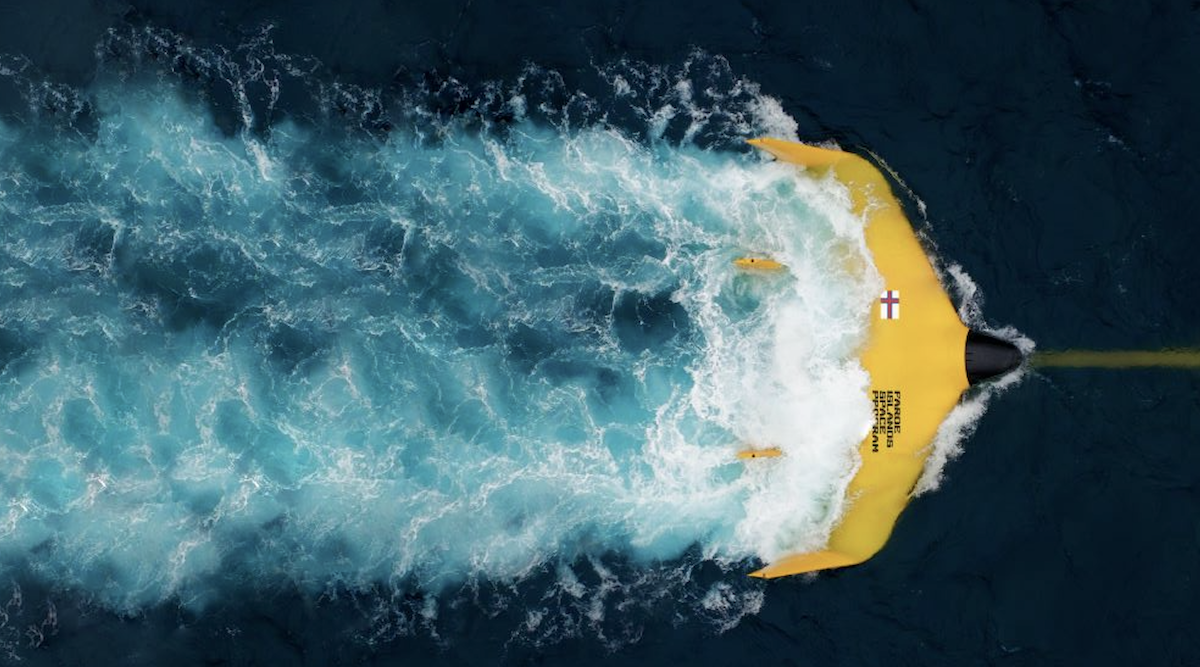
Now that US President Donald Trump has emerged in full flower as a butt-ogling, noise-bleating presence on the 2026 campaign trail, climate advocates are all the more certain that his attempt to throttle back on the nation’s wind and solar industries will ultimately fail. Trump does not hate all forms of renewable energy, though. For example, he has been supporting the marine energy industry all along, perhaps because much of it is hidden under water. Go figure…
📌 The Core Development
Marine energy refers specifically to devices that harvest the kinetic energy of tides, currents, and waves. That’s an important distinction because wind turbines, both offshore and onshore, have earned the wrath of Trump ever since the early 2000’s, when he lost a legal battle against an offshore wind farm that allegedly spoiled the view from one of his golf courses in Scotland. Unlike wind turbines, marine energy devices are barely visible above the surface of the water, so the view-spoiling argument loses quite a bit of steam against them.
That helps explain why the US Department of Energy continues to pour taxpayer dollars into marine energy R&D, even while Trump systematically tries to destroy any and every wind turbine in sight (see more Trump v. wind turbines here ).
🔍 Background & Sector Context
As for potential competition against President Trump’s allies in the fossil fuel industry, no worries. Marine energy is a newly hatched global industry, and it lacks the supply chain and workforce needed for rapid scale-up before it can make any significant contribution to the renewable energy transition. Much of the activity still consists of testing, demonstration, and pilot projects.
Still, if all goes according to plan the payoff will be considerable. The US Department of Energy calculates that wave energy alone could introduce 1,170 terawatt-hours per year onto the nation’s grid.
📊 Industry & Real-World Impact
Siting opportunities for tides and currents are less expansive, but these two parts of the marine energy industry could still make a significant contribution to local and regional decarbonization efforts. The Energy Department estimates that tidal energy could introduce 220 terawatt-hours per year into the grid.
⚡ Prefer Visual Stories on Mobile?
Experience this news piece in an interactive 5-slide visual format crafted for mobile devices & Google Discover.
🔮 Strategic Outlook & What Lies Ahead
The US has been pushing itself forth as a global influence on the marine energy industry since 2010, when the US Navy and Marine Corps partnered with the Energy Department on a wave energy test facility in Hawaii. The Hawaii facility has been upgraded several times since then, and the Energy Department has also established the TEAMER program, which makes a network of US marine energy laboratories available to innovators from around the world. The jewel in the crown is PacWave South, an open ocean test facility off the coast of Oregon which just celebrated its official launch over the summer.
The hum of activity is somewhat more muted around tidal energy. To date, the work has focused on locations where other on-site renewable energy resources are inadequate or impractical. That includes the “RITE” demonstration turbines in the East River in New York City, with the East River being a tidal waterway and not an actual river as commonly understood. Cobscook Bay and Western Passage in Maine are additional targets for tidal energy deployment , along with Cook Inlet in Alaska .