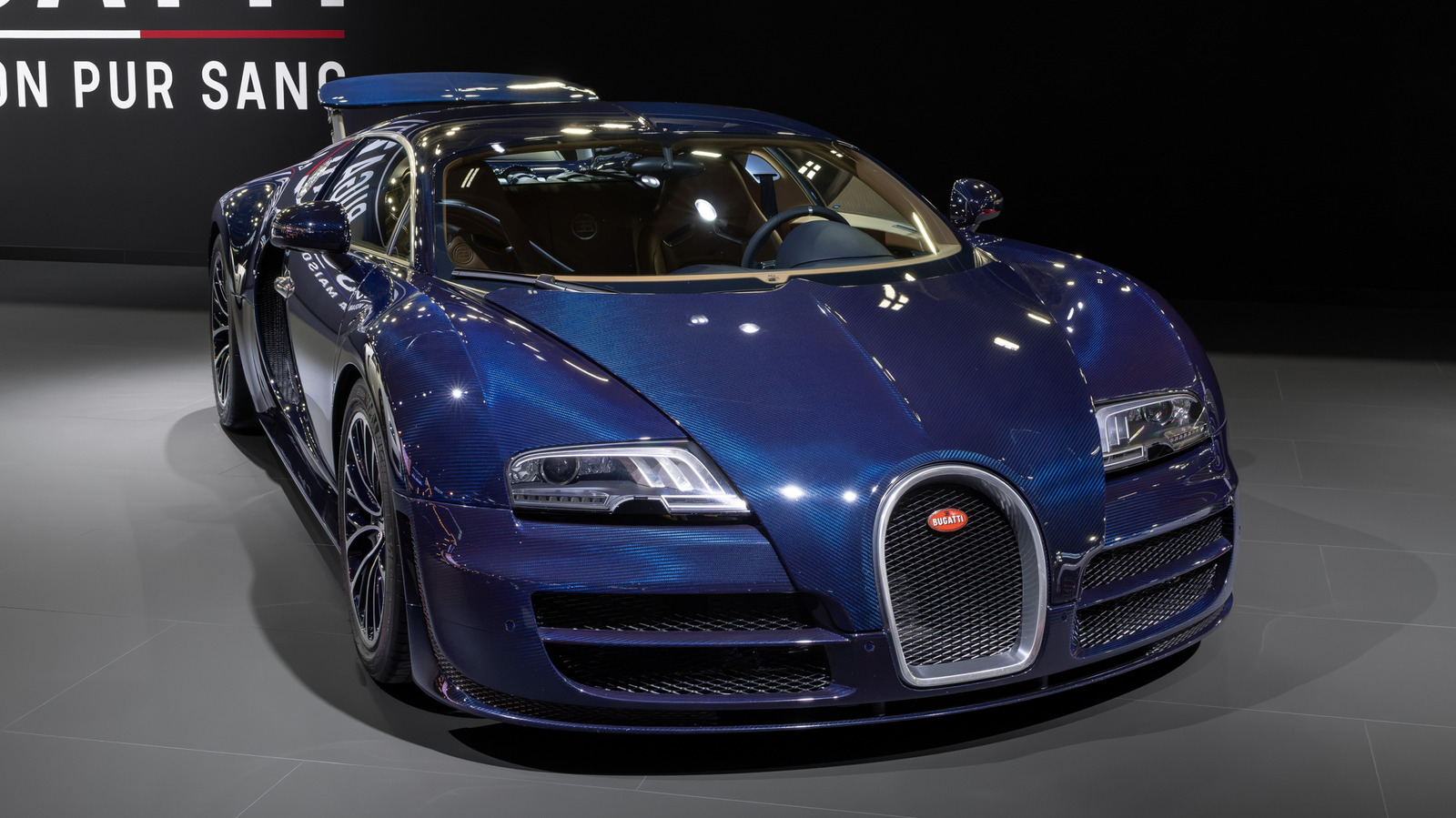
Once you're operating at the very edge of what's possible with a road car, there's no such thing as a minor tweak. On a normal car, a tire is just a tire. At 200-plus mph, it's a countdown timer. The Bugatti Veyron's Michelin tires, which used the same PAX run-flat tech as Honda's Odyssey minivan , were good for roughly 15 minutes at 250 mph, and then they were done.
📌 The Core Development
Nothing at that level is forgiving because every part is already working as hard as it can, and changing one thing drags a dozen others along with it. Just ask Bugatti. The original Veyron made 1,001 horsepower and topped out at 253 mph. It was already the fastest production car on the planet, so there was no easy margin left to borrow.
Getting from there to the 1,200-hp Super Sport, which hit 267.8 mph, took Bugatti two and a half years of development for a 20 percent jump in output. The Super Sport was so extensively re-engineered compared with the original Veyron 16.4 that, in many respects, it was practically a new car. The tub lost 77 pounds, and Bugatti reworked most of the car's essential systems.
🔍 Background & Sector Context
And the proof came early. In a standard Veyron, the 1,200-hp engine destroyed the A/C compressor. Yes, the air conditioning. Think of it as the canary in the coal mine, except the canary was the climate control. Nobody expects cabin cooling to be the weak link on a hypercar, but a part doesn't have to be glamorous to hit its limit. Here's a look at the changes it took to turn the Veyron into the Super Sport, and how that pushed an already extreme car even further.
The compressor's job is to raise the refrigerant's pressure; the condenser then dumps the heat, and the refrigerant goes on to chill the cabin. The Veyron's A/C system also gets its own radiator, the tenth on the car, plus two condensers fed by intakes in the nose. In most cars, a belt connects the crankshaft to a pulley on the compressor.
📊 Industry & Real-World Impact
With the A/C running, a clutch locks the compressor to that pulley, so its speed rises and falls with the engine's. That's the connection to the Veyron's failure. On the Super Sport, peak power moved from 6,000 to 6,400 rpm and torque rose from 922 lb-ft to 1,106 lb-ft. Jason Cammisa, writing for Road & Track , blames an engine that "spun so quickly from idle to redline in first gear." In his earlier MotorTrend feature, he wrote that the A/C system "couldn't bleed off pressure quickly enough."
⚡ Prefer Visual Stories on Mobile?
Experience this news piece in an interactive 5-slide visual format crafted for mobile devices & Google Discover.
🔮 Strategic Outlook & What Lies Ahead
Things like this can happen when you're engineering a 1,200-horsepower car, something very few engineers likely had ever attempted before the Super Sport. And the challenges went well beyond the engine. Even the tires had to be specially engineered to withstand the speeds Bugatti was chasing with the Veyron and Chiron .
The Chiron kept the Veyron's 8.0-liter, four-turbo W16 layout and took it to 1,500 horsepower. Its A/C compressor is rated for up to 10 kW of cooling, which Bugatti conveniently compares to chilling a European apartment of roughly 860 square feet, and the Pur Sport's engine revs to 6,900 rpm. It's tempting to read that as a lesson from the Super Sport, but we'll likely never know.