Heading into the 1960s, Detroit's Big Three had begun to realize some folks preferred cars that were more agile and more efficient than the typically massive machines they were producing. Their response was to introduce a wave of home-grown compacts in 1960, led by GM's Chevrolet Corvair, the Chrysler Valiant, and the Ford Falcon.
📌 The Core Development
On the truck side of the ledger, though, things played out differently. Datsun had been exporting compact trucks to the West Coast since the first half of the 1960s, with Toyota following soon after. The Big Three at the time offered car-based trucks like the Corvair forward-control models and the Falcon-based ute-style Ranchero, but they didn't look like the real deal the way the Japanese mini-trucks did. So when the mini-truck segment began taking off, the U.S. automakers went straight to the easiest option. Ford rebadged Mazda's B-series truck to sell as the Courier for 1972. The same year saw GM give that treatment to the Isuzu Faster, with the result being the Chevy LUV — a truck way ahead of its time .
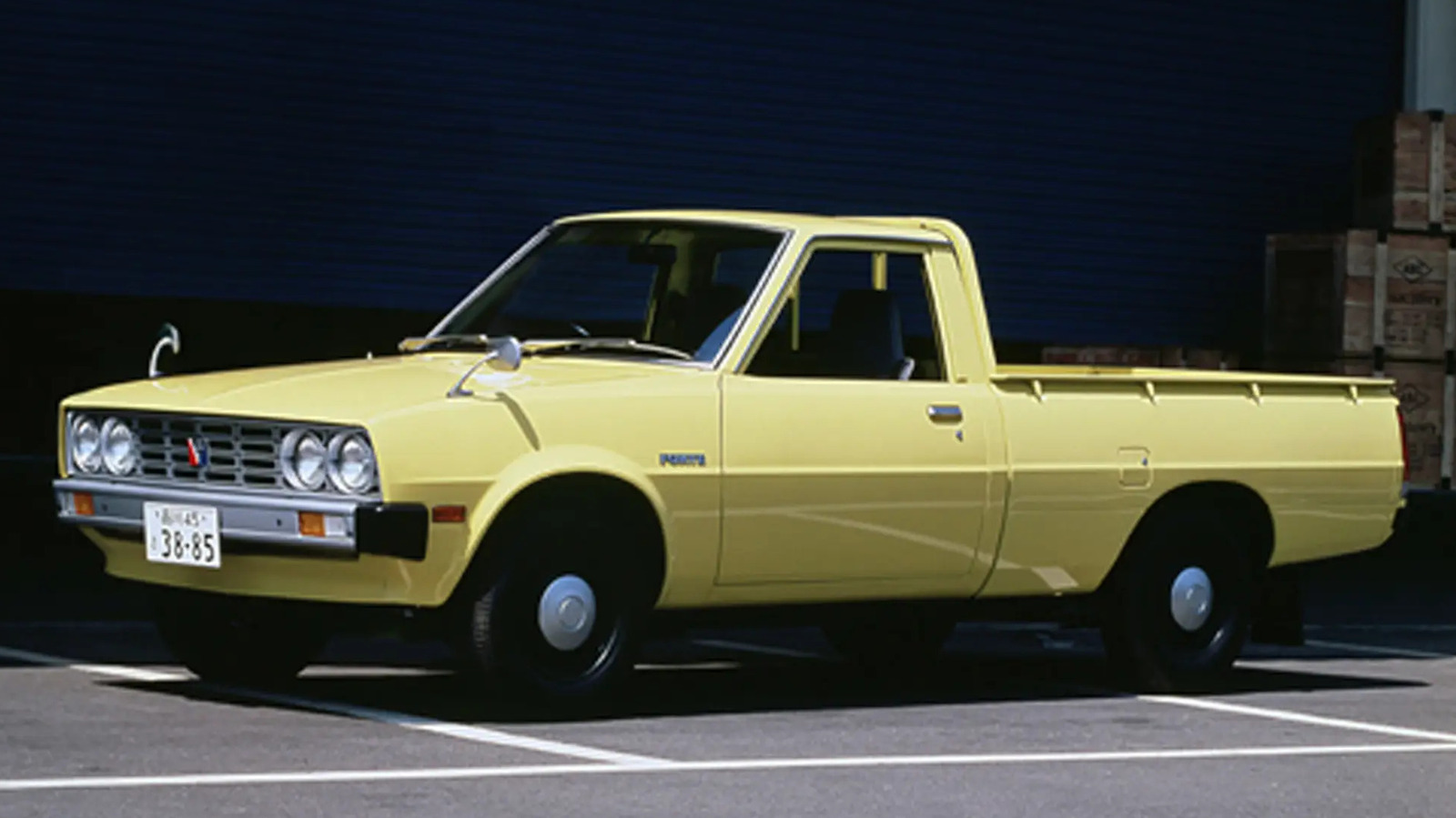
As a result, the Courier and LUV, and their Japanese-branded rivals, were in the right place at the right time when the fuel crises of 1970s hit, starting in 1973. Chrysler's entry, though, was way behind. Based on the Mitsubishi Forte, the Dodge D-50 didn't debut until 1979, some seven years after the Courier and LUV. (To be clear, the D-50 would be renamed the Dodge Ram 50 in 1981, and Mitsubishi's Forte is unrelated to Kia's former compact sedan of the same name.)
🔍 Background & Sector Context
Unlike today, compact pickups of the past were literally compact. So the 1979 Dodge D-50 pickup had a slightly smaller footprint than a 2026 Honda Civic sedan. The D-50 is 184.6 inches in length and 65 inches wide, while the Civic is 0.2 inches longer and 5.9 inches wider. As for a modern "compact" pickup, the Ford Maverick is 15.2 inches longer, 7.6 inches wider, and 8 inches taller.
The D-50's power train was likewise fairly small. The standard mill was a 2.0-liter overhead-cam inline-4 capable of 93 horsepower and 108 pound-feet of torque, and it was paired with a four-speed manual transmission. For the D-50 Sport, a 2.6-liter I4 with 105 horses and 139 lb-ft was standard with a five-speed automatic with overdrive. A three-speed automatic was optional with both versions.
📊 Industry & Real-World Impact
More impressive was the D-50's maximum payload of 1,400 pounds. By 1981, when the D-50's payload rating reached 1,525 pounds, it could out-carry the '26 Maverick, which has a 1,500-pound payload.
Benchmark Telemetry & EV Fuel Savings
Put top supercars and EVs to the test in The Pit Stop Lab — launch head-to-head 1/4-mile drag strip battles & compute EPA electric fuel cost savings.
⚡ Prefer Visual Stories on Mobile?
Experience this news piece in an interactive 5-slide visual format crafted for mobile devices & Google Discover.
🔮 Strategic Outlook & What Lies Ahead
The year 1981 further marked two other milestones for the Dodge. The first was a marketing change. Ram and Dodge aren't the same brand anymore , having split up in 2009, but they were still connected at the time. And in 1981, when Chrysler was readying its new truck lineup for the year, the decision was made to add the Ram name to the roster – transforming its compact into the Dodge Ram 50. The next year saw the Ram 50 welcome its first 4x4 configuration, complete with another new marketing move that positioned the truck as the Power Ram 50. The truck even offered a diesel power plant from 1983 to 1985.
The Dodge Ram 50 would go on to get a second generation in 1987, and that model would remain in production until 1994. Yet not only wasn't it the smallest Dodge pickup ever produced, it wasn't even the smallest Dodge pickup of its era. That honor goes to the Dodge Rampage.