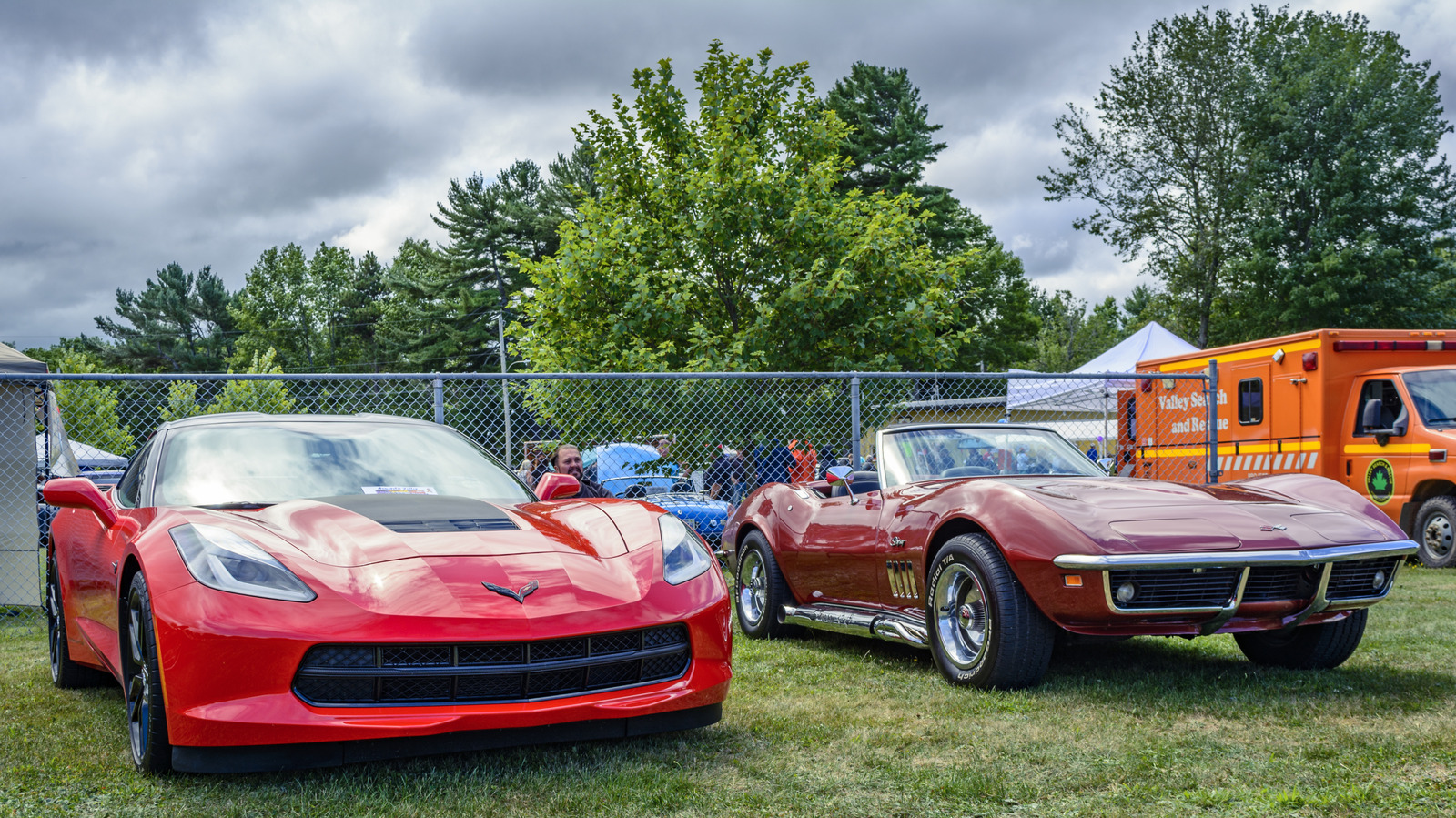
The Chevrolet Corvette has been Detroit's answer to the European sports car for more than seventy years. Since 1953, it has gone through eight distinct generations. The idea behind the Corvette came from Harley Earl, former head of design at General Motors, who envisioned an affordable two-seat roadster that could stand beside the imports returning stateside with World War II veterans. The first Corvette shipped with a six-cylinder engine, and it was Zora Arkus-Duntov (later nicknamed the " Father of the Corvette ") who pushed the car towards the V8 power it would become known for.
📌 The Core Development
From there, the Corvette never stopped evolving. The front-engine layout that defined the nameplate for decades was finally abandoned when the eighth generation arrived with its engine behind the driver, a change that purists argued about — and the stopwatch quietly settled. What makes the Corvette so interesting is that it has always been judged by two audiences. One cares about straight-line muscle and badge pride. The other, which is usually more critical, cares about how a car handles when the road bends. And for a car built to take on Porsche, Jaguar, and Ferrari, that second audience matters just as much as the first — if not more.
That is where skidpad grip comes in. Measured in g-force, it shows how hard a car can corner before the tires let go of the road. This measurement largely sidesteps horsepower and driver skill (as you'll see throughout this article), instead mostly being affected by tires, suspension, and chassis balance. To keep the numbers easier to digest, this article leans on Car and Driver 's skidpad, which is 300 feet across in its modern tests and 200 feet in older ones. Other testers will be relied on only where necessary.
🔍 Background & Sector Context
In terms of available and credible test results online, the C7 is where the front-engine Corvette actually peaked. On Car and Driver's 300-foot skidpad, the 2015 Z06 with the Z07 package "scorched the skidpad with 1.19 g." At the time, no production car had logged a higher figure on that pad. The Z06 also managed to stop in 128 feet from 70 mph to 0, cross the quarter mile in just 11 seconds at 126 mph, and do a 0 to 60 mph run in just 2.9 seconds.
Behind that number sat a supercharged 6.2-liter V8 rated at 650 horsepower, as well as Michelin Pilot Sport Cup 2 ZP tires. Weight-wise, the car itself is rated at 3,558 pounds. Car and Driver also posted impressive numbers with the 2017 Corvette Grand Sport, which managed to hold 1.18 g even with 190 fewer horsepower than the Z06, showing how engine strength doesn't matter as much as other factors for grip. Braking from 70 mph took 129 feet, the quarter-mile took 12.2 seconds, and 60 mph arrived in 3.8 seconds. And the Grand Sport is only slightly lighter than the Z06, tipping the scales at 3,452 pounds.
📊 Industry & Real-World Impact
Interestingly, the Z06's 1.19 g is also higher than anything the C8 posted in Car and Driver's tests. Even the 1,064-horsepower 2025 Chevrolet Corvette ZR1 managed a curiously low 1.13 g. In other words, the C7 Z06's 1.19 g is a measurement that no other Corvette generation could match.
Benchmark Telemetry & EV Fuel Savings
Put top supercars and EVs to the test in The Pit Stop Lab — launch head-to-head 1/4-mile drag strip battles & compute EPA electric fuel cost savings.
⚡ Prefer Visual Stories on Mobile?
Experience this news piece in an interactive 5-slide visual format crafted for mobile devices & Google Discover.
🔮 Strategic Outlook & What Lies Ahead
The mid-engine C8 had every reason to beat the C7 here. It is the newer car, it has the newer rubber, and it has more horsepower across the board. The Z06's 5.5-liter flat-plane-crank V8 makes 670 horsepower, and the Z07 package has the car riding on Michelin Pilot Sport Cup 2 R tires. But on Car and Driver 's 300-foot skidpad, the Z07-equipped Z06 recorded 1.16 g. Chevrolet's own number for the car was 1.22 g, and Car and Driver noted that this result was "well below the company's estimate." The publication later explained that the Z07's tires had been inflated to the door-placard pressure rather than Chevrolet's lower track recommendation, potentially limiting its measured grip.
Regardless, even if we look at the rest of the lineup, the C8 failed to match the C7 in Car and Driver's tests. The non-Z07 version of the Z06 convertible hit 1.12 g, and the Stingray reached just 1.03 g. Later Car and Driver tests didn't move the number; as mentioned, the ZR1 reached 1.13 g, while the 1,250-horsepower ZR1X came in at 1.15 g. That leaves the C8 0.03 g behind the C7 Z06's result in Car and Driver's testing.