
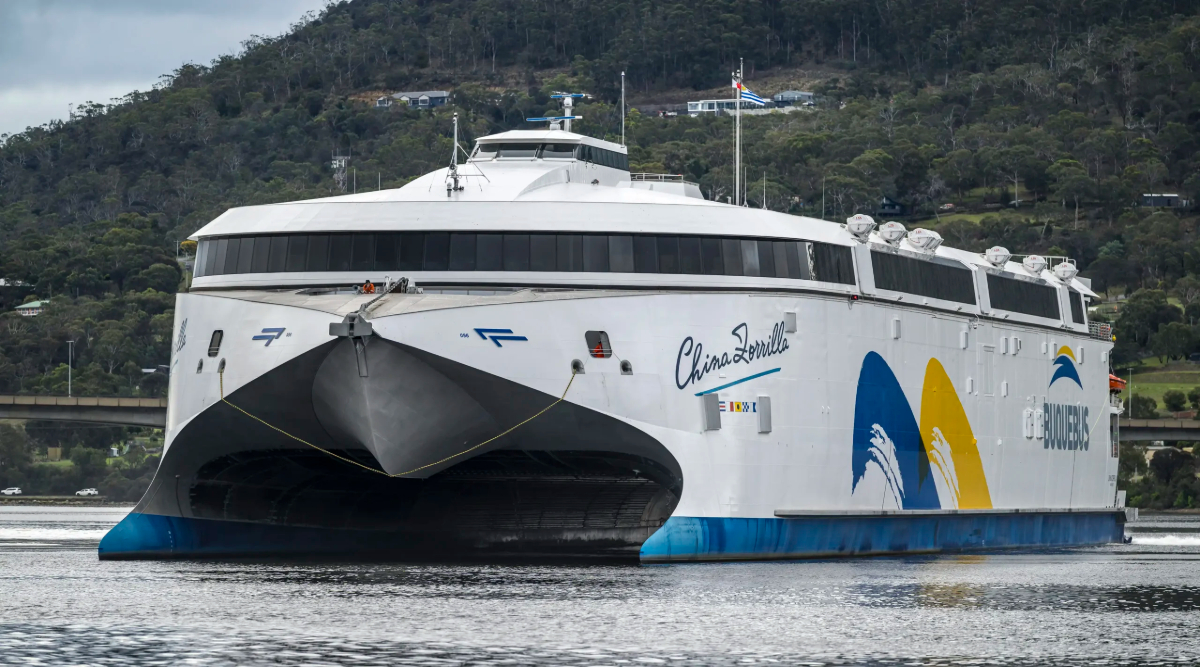
Buenos Aires, Argentina is separated from Colonia, Uruguay by the Rio de la Plata estuary. While it is possible to drive between the two cities, it is faster and more convenient to take a ferry ride. Buquebus, a popular ferry operator in Buenos Aires, offers round trip excursions to Colonia for a mere $43.00 — a deal if there ever was one. But, wait, it gets better. Today, that journey can take place aboard the China Zorrilla, the world’s largest electric ferry .
📌 The Core Development
Don’t let the name fool you; this ship was not manufactured in China. It is named after the popular Uruguayan actress and director Concepción “China” Zorrilla, who is much beloved in both countries. In fact, it was made by Incat in Tasmania, a company that specializes in catamaran style ships. It refers to this vessel simply as Hull 96, which is an aluminum catamaran.
The vessel is 130 meters (426 feet) long and can carry 225 cars and 2100 passengers. Once aboard, those passengers will enjoy all the comforts of a cruise ship, with a variety of dining and shopping opportunities during the approximately one hour long crossing. The ship has a gross tonnage of 14.058 tons and can skim along at 25 knots (29 mph), powered by eight 2400 kW (3200 HP) electric motors that feed eight water jets supplied by Wartsilla . The electricity comes from a 41.2 MWh 250 ton battery pack from Corvus Energy that can be recharged by two 8 MW chargers.
🔍 Background & Sector Context
“The water jet propulsion configuration with eight electric motors is the most efficient available on the market today for this speed range and type of application, while also offering all the benefits of Wärtsilä’s axial-flow water jet technology — lightweight, shallow draft, excellent maneuverability, and low maintenance,” said Roger Holm, president for marine power at Wärtsilä.
Incat says the start of operations by China Zorrilla is an important milestone for the electrification of maritime transport. CEO Robert Clifford stated, “This is a truly historic day for Incat, for Tasmania, and for the global maritime industry. Over the years, hundreds of talented people at our shipyard in Hobart have worked tirelessly to make this extraordinary vessel a reality. We have overcome immense technical challenges, pushed the boundaries of what was previously thought possible, and created something the world has never seen before.”
📊 Industry & Real-World Impact
He added the fact that the ferry is now carrying passengers in commercial operation while being fully powered by batteries is an incredible achievement and “a moment of great pride for everyone involved in this journey.”
⚡ Prefer Visual Stories on Mobile?
Experience this news piece in an interactive 5-slide visual format crafted for mobile devices & Google Discover.
🔮 Strategic Outlook & What Lies Ahead
The China Zorrilla electric ferry demonstrates that even large commercial vessels with high transport capacity can be fully powered by batteries instead of fossil fuels — an important milestone for the shipping industry.
A battery electric vessel will give passengers a quieter crossing that is free from the engine noise, vibration, and stench of exhaust fumes that are typical of diesel propulsion. The fact that the ferry has no direct exhaust emissions of its own while it is in operation is an important bonus.


