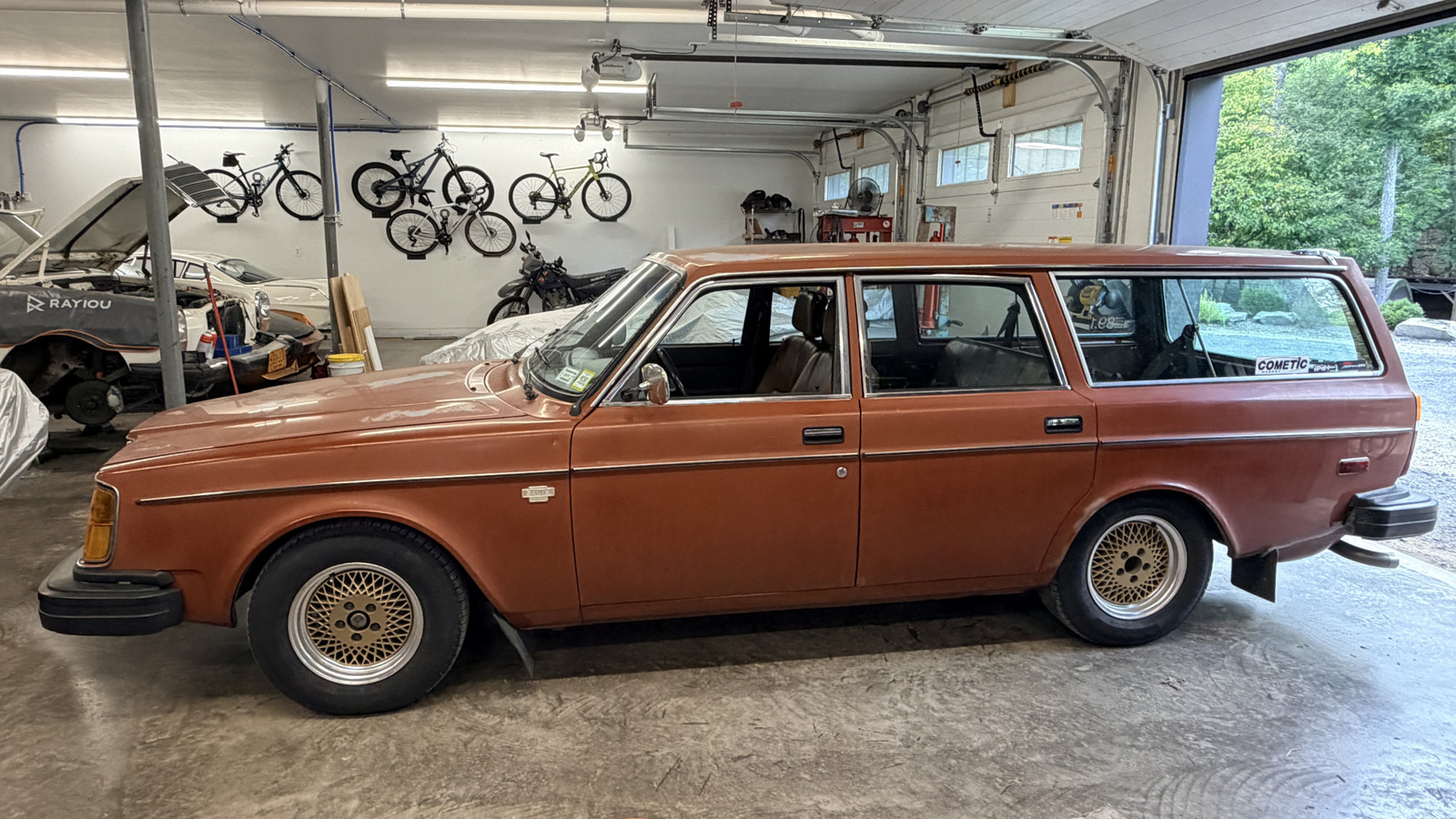
That's my brick. It's a faded red. Officially, Volvo calls it Cimarron Red, but why didn't they just call it Brick? Anyway, the hue isn't — or at least hasn't been — my focus since I acquired the car from Eureka, California, a year and a half ago. Yes, I also hunted Volvo 145s, but most I spied needed way too much TLC — like this one . There was just one problem with my brick: The prior owner ditched the stock fuel injection, known as Bosch K-Jetronic, which came on U.S.- and Canadian-bound versions of the B21F engine in the late 1970s. Instead, he switched to a throttle-body fuel injection , by way of the Holley Sniper EFI 1100. The car never ran right with the Holley, and my mechanic friend, Ryan, made two damning points about its shortcomings.
📌 The Core Development
First, it lacks an Internal Air Temperature sensor (IAT). For about the same $1,100, Summit Racing sells a throttle body kit with an IAT, but it didn't come on the Holley. Ryan said the reason that matters is because you want a live reading of air density during combustion. He explained that Holley's downstream sensing (in the exhaust) was always back-calibrating the ratio of fuel and air. The system I had also only allowed code tweaks via an SD card.
Sure, you could purchase a setup to live-calibrate the Holley with a laptop, but without an IAT, I would still have zero guarantee of smooth operation in the future. So, I was left with two choices: to find a salvaged K-Jetronic, or go even farther back in time and revert to a carburetor. I went the latter route, and the decision came down to me being a cheap automotive journalist. Well, mostly.
🔍 Background & Sector Context
Trust me, I considered finding a viable K-Jetronic mechanical fuel-injection solution. K-Jet in various forms dates all the way to the late 1960s, and was used by many other carmakers, including Volkswagen and Mercedes-Benz. I'm not telling you exactly what I paid for my car, but I will tell you, as I already have, that it wasn't a fortune — nor do I have one to spend on making a not-mint Volvo into a parts-perfect museum piece.
Just to make this clear, K-Jet consists of a fuel pump, accumulator, fuel filter, airflow sensor, warm-up regulator, fuel distributor, injectors, cold start injector, Thermotime switch, and auxiliary air device. I'd need to acquire all of that. Then I'd need the right manifold, too, since that was long gone from my car. I'd also have to fetch the correct wiring harness for $320 from an outfit called, fittingly, Prancing Moose. I'd already sourced a harness from there for the overdrive my buddy Joe put in my car. I held the flashlights and whinged along with Joe, who did all the actual work and troubleshooting.
📊 Industry & Real-World Impact
Anyway, even tabulating costs with a dull pencil and a greasy napkin, I was sure going the K-Jet path would cost me far north of $1,000. Yep, a junkyard K-Jet might work. Or I might be rebuilding every single part. Rebuild kits exist from the likes of Volvo parts supplier IPD and Australia's K-Jet Specialists . Still, assembly would be delicate and fussy, and I'd need tools I don't have, like pressure-testing equipment required to get the calibration just right.
Benchmark Telemetry & EV Fuel Savings
Put top supercars and EVs to the test in The Pit Stop Lab — launch head-to-head 1/4-mile drag strip battles & compute EPA electric fuel cost savings.
⚡ Prefer Visual Stories on Mobile?
Experience this news piece in an interactive 5-slide visual format crafted for mobile devices & Google Discover.
🔮 Strategic Outlook & What Lies Ahead
Going the carb route wasn't as crazy as it sounds. My same 240, sold in other markets, got a B21A engine with a Stromberg carburetor. And, actually, the last carbureted car sold new in America was on the market in 1994, which just shows you that early fuel injection hardly convinced every carmaker that it was the perfect fueling solution. As for which carb path to take, I could have spent $892.14 for that original B21A Stromberg. But why do that when Classic Car Performance sells a complete Weber 32/36 DGEV conversion kit for $569.99? And because the Holley conversion meant I already had a perfectly good Pierce manifold on the 245, I knocked off another hundred bucks by not needing that part.
As I saw it, the benefit of deciding to use the Weber was relatively simple tuning and mechanical simplicity. As a reminder, a carburetor has jets that are essentially screws with holes in them precisely sized to allow the right amount of fuel to get sucked in as air passes through the barrel (or barrels), controlled by a drop in pressure, and the gas-and-air mixture gets ignited within the engine.