
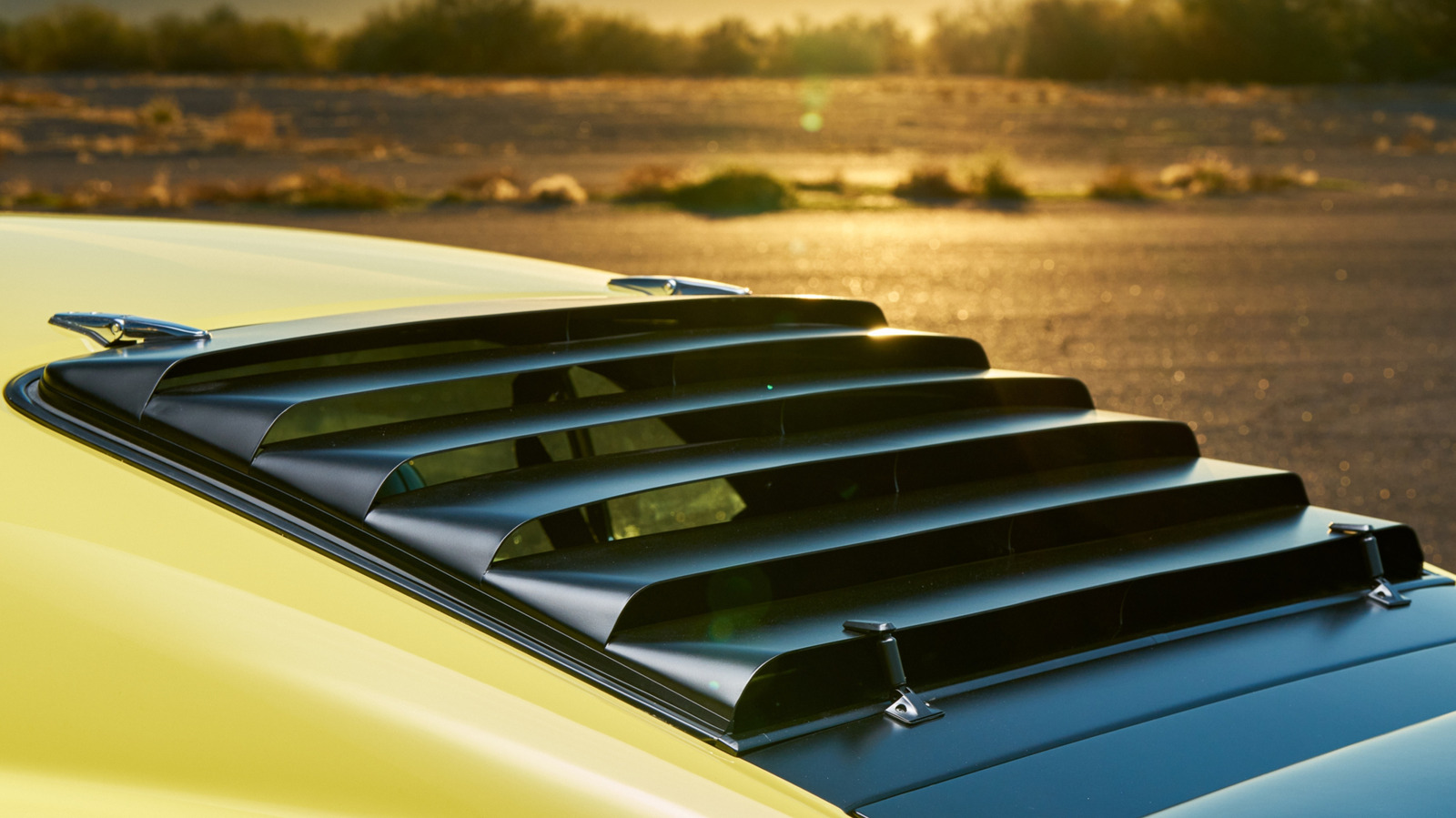
A big V8 making more horsepower than anyone could justify was only part of the package in a 1960s or 1970s muscle car. Detroit's factory hot rods also popularized features like hood scoops, all manner of bold graphics , and a trend for window louvers on performance cars that continued long after the original muscle car craze died. Window louvers are the slats you sometimes see on the back of cars, like the 1969 Ford Mustang Boss 302 or second-generation Chevy Camaros.
📌 The Core Development
They're dark-colored horizontal strips of metal or plastic, joined together to form a frame that sits on top of the rear widow. You'll sometimes see them fitted to notchback coupes, cars with a more traditional three-box silhouette. But usually its fastbacks that saw the louver treatment. And there's a good reason for that. A car interior can get really hot when the sun's rays are blasting a large expanse of shallowly raked glass on a fastback muscle car. And that was a problem in the late 1960s when this body style was more popular.
🔍 Background & Sector Context
Air conditioning was still an expensive option back then, and window tints were in their infancy, so drivers looked for new ways to keep cool. And, let's be honest, to look it. Like slatted shutters on a house window, car window louvers help minimize the effect of the sun, without totally blocking out the light. But also like residential shutters, car window louvers improve privacy and have a very distinctive look, one that added to the gritty visual appeal of a muscle car back in the day.
📊 Industry & Real-World Impact
House builders have used louvers for thousands of years, and automakers have stamped metal louvers into panels to vent engine heat since at least Buick Roadmasters from the 1940s. But the best known early automotive use of louvers as we understand them, is on the Lamborghini Miura. The Miura debuted at the 1966 Geneva Auto Show with a plexiglass window covering its 4.0L V12, but Lamborghini's engineers soon realized the screen trapped huge amounts of heat generated by the 350-horsepower engine.
⚡ Prefer Visual Stories on Mobile?
Experience this news piece in an interactive 5-slide visual format crafted for mobile devices & Google Discover.
🔮 Strategic Outlook & What Lies Ahead
Designer Marcello Gandini replaced the window with louvers, and 60 years on it's hard to imagine the Miura without them. Other automakers soon picked up on the trend. Ford — which had already employed fixed metal louvers on the rear quarter windows for its 1965 Mustang — offered rear window "Sports Slats" on 1969 Mustangs ordered with the SportRoof fastback body. A year later, Chrysler rolled out louver packages on the Dodge Challenger and Plymouth Barracuda. Both types were made from aluminum and fitted over the rear window, rather than replacing it, as the Miura's had.
By the mid-1970s, America's aftermarket industry was offering louver kits for dozens of different models. Japanese coupes like the Datsun 280Z and Mazda RX-7 were prime for a louver makeover, and kits often featured matching rear quarter-light louvers. They were still popular through the 1980s, and although the rise of window tints and the smooth, aerodynamic styling of the 1990s saw louvers fall out of favor, they've since gained a second life. Lamborghini still references the Miura's louvers on its modern Temerario and Reveulto supercars, Chevy deploys them on its ultra-high performance C8 Corvette ZR1 , and you can buy aftermarket louvers for everything from the Toyota GR86 to the BMW 4 Series.


