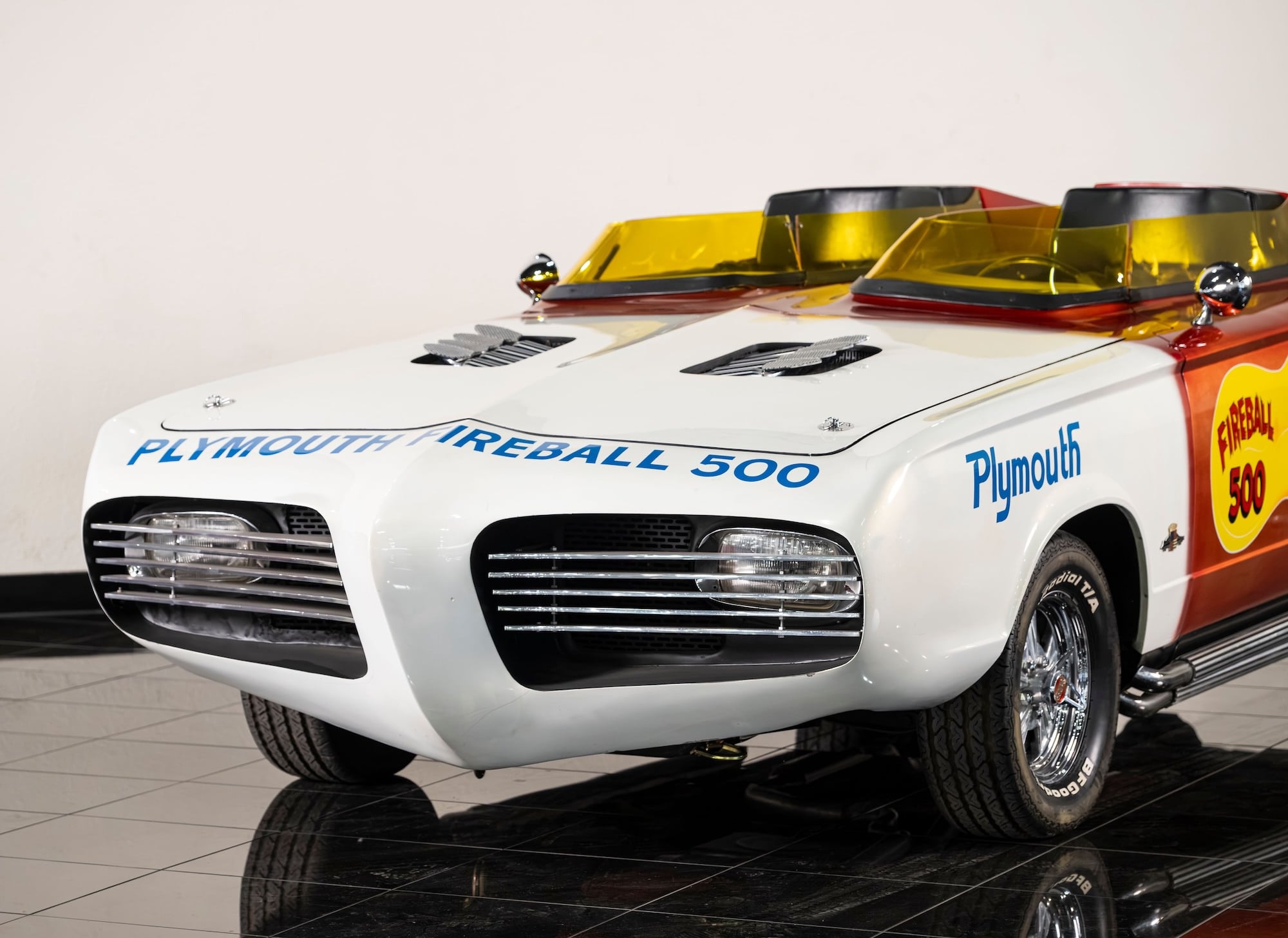
This is the Plymouth Fireball 500 by Barris Kustom, it was built as Frankie Avalon’s character’s hero car for the 1966 film also named “Fireball 500.”
📌 The Core Development
The car wasn’t just a show pony, when new it was said to be powered by a 426 cubic inch (7.0 liter) Hemi V8 mated to a 4-speed manual gearbox, and it had a reported top speed of over 160 mph – a highly-respectable achievement in the mid-1960s.
When it was first built by George Barris, the Fireball 500 was powered by a 426 cubic inch (7.0 liter) Hemi V8, with a 4-speed manual transmission. The car was essentially a heavily-rebuilt 1966 Plymouth Barracuda that had been ordered by American International Pictures from Barris in late 1965 and Chrysler supplied the donor car. Interestingly, Barris was turning a Lincoln Futura concept car into the Batmobile at the same time in the same garage.
🔍 Background & Sector Context
This is the “Fireball 500” by Barris Kustom, it was built for Frankie Avalon as the hero car for the 1966 film also named “Fireball 500.”
The first-gen Barracuda was a fastback version of the Plymouth Valiant, launched in April of 1964 with a curved 14.4 square foot rear window. As cool as that rear screen might have been, Barris didn’t need it, so he removed it, along with the roof.
📊 Industry & Real-World Impact
In their place his team built two separate cockpits, each had its own cowl hand-formed from metal and a curved windshield made from butyrate plastic. Flared headrests were added around each cockpit opening and ran back into the rear bodywork. There, four razor-edged fins were molded as a single metal section covering what had been the rear seat and trunk lid. It was a wild looking car, even before the paintwork was applied.
Benchmark Telemetry & EV Fuel Savings
Put top supercars and EVs to the test in The Pit Stop Lab — launch head-to-head 1/4-mile drag strip battles & compute EPA electric fuel cost savings.
⚡ Prefer Visual Stories on Mobile?
Experience this news piece in an interactive 5-slide visual format crafted for mobile devices & Google Discover.
🔮 Strategic Outlook & What Lies Ahead
The rear fenders were extended and the vertical taillights were lengthened by four inches, rectangular headlights imported from France sat in a reworked grille up front. The wheel wells were enlarged for 700/12.50-13 Firestone tires on 13-inch spoked alloy wheels, side exhausts built from Reynolds aluminum extrusions ran along the rockers, and eight air-intake tubes sat in the hood. Inside, a 13-inch deep-dish steering wheel was fitted as it suited the tight dimensions of the cockpit.
The paint was called Fireheat, it required 40 coats of hand-rubbed lacquer shaded from pearl white through to gold and tangerine to candy red and finally burgundy. It’s said that four men spent six days spraying it, layer after layer.