If you had told a Group B spectator back in the '80s that the spirit of the monstrous rally cars would be resurrected forty years later without a single drop of gasoline, they would have probably laughed. However, that's exactly what happened with two French unicorns from Renault and Peugeot, swapping their turbocharged engines for electric motors and battery packs.
📌 The Core Development
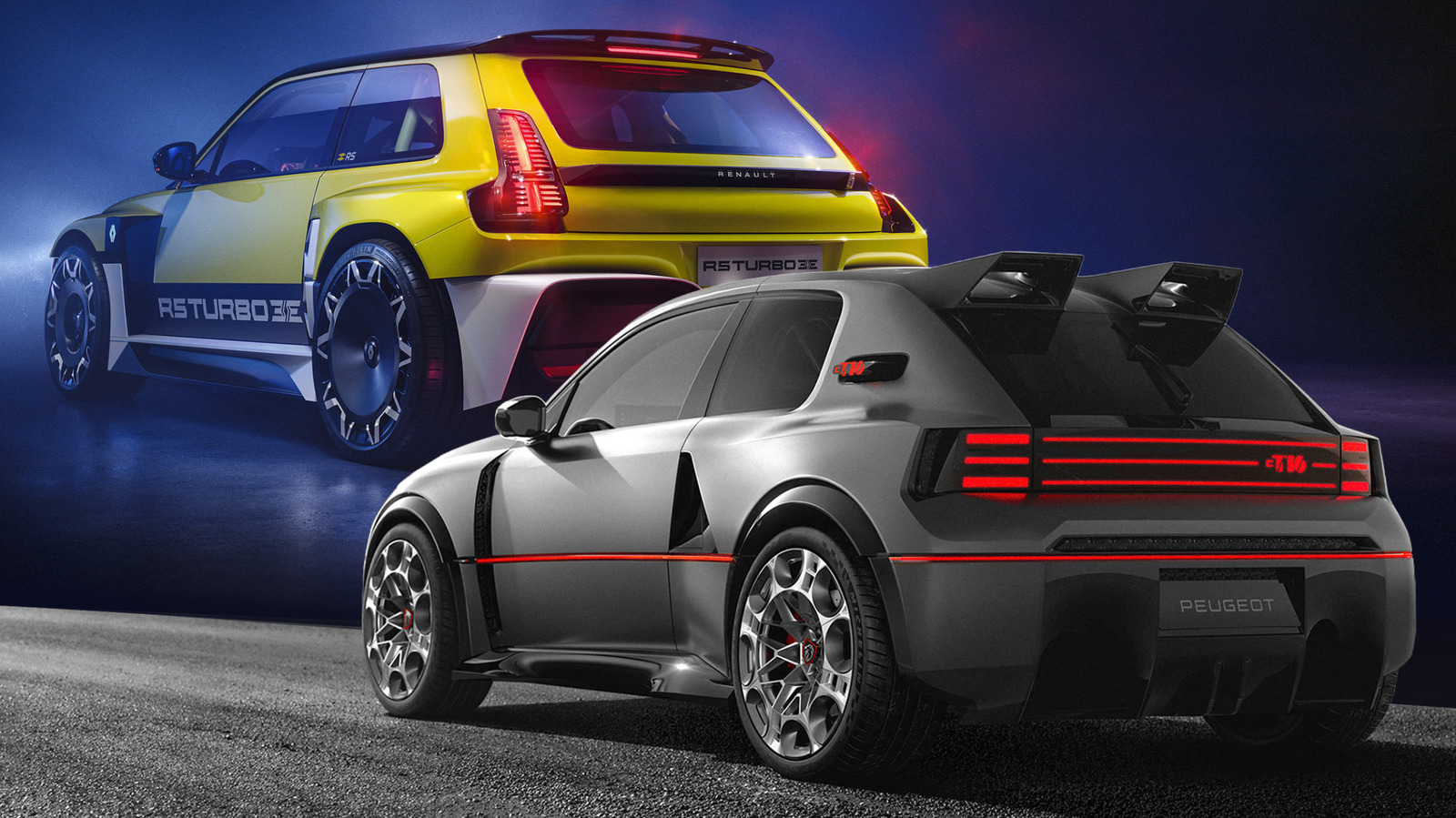
We're talking about the spiritual successors of the mid-engine rear-wheel-drive Renault 5 Maxi Turbo and the all-wheel-drive Peugeot 205 T16, both envisioned as fully electric wide-bodied hyper hatchbacks. In order to see which did it best, we gathered photos and specs in an early comparison, well before anyone has had a chance to drive them back to back. First came the Renault Turbo 3E, with a retro-flavored concept study in 2022 evolving into a limited-production 535-hp supercar special in 2025. Meanwhile, the Peugeot e-T16 concept debuted in 2026, and could be heading to production in 2027.
While both models revive motorsport icons from the past, there is a fundamental difference in their design intentions. The Renault is a flagship performance EV that bridges the gap between the classic R5 Turbo and the new R5 E-Tech, while the Peugeot is a cleverly disguised hyper-aggressive preview of the 208 hatchback which is due in 2027 . Still, with both rally-inspired EVs targeting a similar niche, many collectors will be divided on which one will end up in their dream garage (if not both).
🔍 Background & Sector Context
Starting with the exterior design, the R5 Turbo 3E looks like a modernized version of its legendary Group B descendant, with futuristic styling cues such as the fancy LEDs, advanced aerodynamics, and the 20-inch alloy wheels. On the other hand, the Peugeot e-T16 Group B rally homage leans into the modern era, although it carries the spirit of the 205 in its the characteristic greenhouse, red stripes, and boxy taillights. What's new is the three-slot full-width LED graphics on the headlights and the taillights, set to become a signature trait of future Peugeots.
It also rides on slightly larger 21-inch alloys with wider tires at the back. Both models stay true to the motorsport theme by adopting aggressive bumper intakes, prominent splitters, ultra-wide fenders with integrated vents, deep side skirts, sizeable rear diffusers and roof spoilers. Despite the fact that all production superminis now have five doors, the French hyper hatchbacks retain the traditional three-door layout that used to be the norm.
📊 Industry & Real-World Impact
While automakers created the original Group B hatchbacks by ripping out the rear seats and placing a combustion engine behind the driver, their modern successors rely on clever EV packaging to replicate that mid-engined feel. The Renault uses a bespoke aluminum tubular chassis developed by Alpine, and a floor-mounted 70-kWh battery contributing to a 43/57 weight distribution. As with the original, the R5 Turbo 3E remains rear-wheel-drive.
Benchmark Telemetry & EV Fuel Savings
Put top supercars and EVs to the test in The Pit Stop Lab — launch head-to-head 1/4-mile drag strip battles & compute EPA electric fuel cost savings.
⚡ Prefer Visual Stories on Mobile?
Experience this news piece in an interactive 5-slide visual format crafted for mobile devices & Google Discover.
🔮 Strategic Outlook & What Lies Ahead
Dual electric motors produce a combined 555 horsepower (410 kW/563 PS), allowing a 0-100 km/h (0-62 mph) sprint in under 3.5 seconds. The Renault is also the lighter of the pair, weighing 1,450 kg (3,197 lbs). The Peugeot utilizes Stellantis' new STLA One global architecture , but stays true to the all-wheel-drive nature of the 205 T16. Three electric motors produce a combined 816 hp (600 kW/827 PS), easily outgunning the Group B rally cars of the past.
Acceleration is even more impressive, launching from 0-100 km/h (0-62 mph) in 2.5 seconds. The battery has a capacity of 85 kWh and promises to have enough juice for three consecutive laps around the Nürburgring. While Peugeot hasn't published the exact curb weight, they state the e-T16 has a power-to-weight ratio of under 2 kg/hp (4.4 lbs/hp), hinting at a 1,632 kg (3,590 lbs) figure. As for charging, the Renault can go from 15-80% and the Peugeot from 10-80% in about 15 minutes as long as you have access to the right charger.