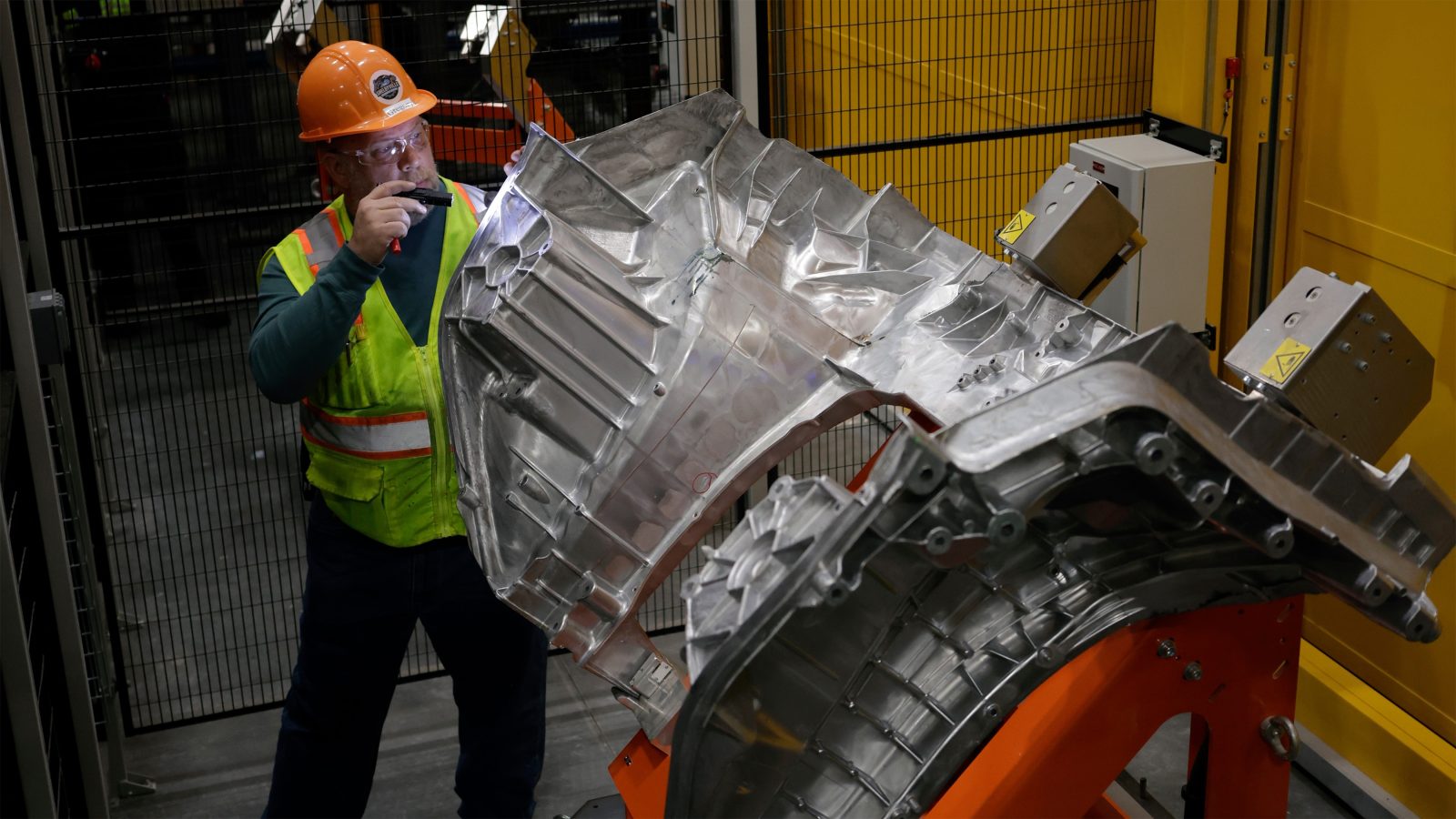
Ford has now produced more than 5,000 large aluminum “unicastings” for the Fathom, its upcoming $28,350 midsize electric pickup, as it fine-tunes the process ahead of a 2027 launch.
📌 The Core Development
Each truck gets two of them, front and rear, replacing 146 individual parts. It’s the clearest sign yet that Ford is all-in on the manufacturing approach Tesla popularized with its Giga Press six years ago.
The update comes from Vladimir Bogachuk, Ford’s chief engineer of advanced vehicle structure architecture, in a post on Ford’s From the Road blog . The castings are made at Ford’s Shelbyville Technical Center and shipped to Louisville Assembly Plant for process testing and prototype builds. Louisville is the Kentucky factory Ford is retooling for the Fathom and other vehicles on its Universal EV Platform .
🔍 Background & Sector Context
Ford melts aluminum ingots at about 1,300°F (700°C) and injects the metal into either a front or rear structure mold. Once a robot pulls the part out, it goes into a quench tank, gets trimmed and machined, and then runs a gauntlet of checks: industrial X-ray scans for pores and voids, dimensional measurements in a climate-controlled room, optical surface scans, and lab tensile and chemistry tests on samples.
Nothing ships to Louisville until a batch clears every inspection. Ford says it’s also working on cutting cycle time and on designing the castings for “modular repairability.”
📊 Industry & Real-World Impact
That last part has been the main reason why automakers have been reticent about larger cast parts. Repair cost is the biggest knock on giant castings, since a damaged one-piece structure can turn a moderate crash into a write-off. Lucid executive Cory Steuben has said insurance concerns drove the company’s decision to skip gigacasting altogether.
⚡ Prefer Visual Stories on Mobile?
Experience this news piece in an interactive 5-slide visual format crafted for mobile devices & Google Discover.
🔮 Strategic Outlook & What Lies Ahead
Tesla kicked this off in 2020 with the first IDRA Giga Press at Fremont, a machine with roughly 6,000 tons of clamping force. It cast the Model Y’s rear underbody in a single piece , replacing 70 parts, and Elon Musk said the change removed the need for about 300 robots.
Tesla wanted to go much further. It added a front casting, tied the two together with a structural battery pack, and moved to even bigger presses for the Cybertruck. But in 2024, Reuters reported that Tesla had backed away from its plan to cast nearly the entire underbody in one piece, and the automaker has reportedly since dropped the front casting on some Model Y production.