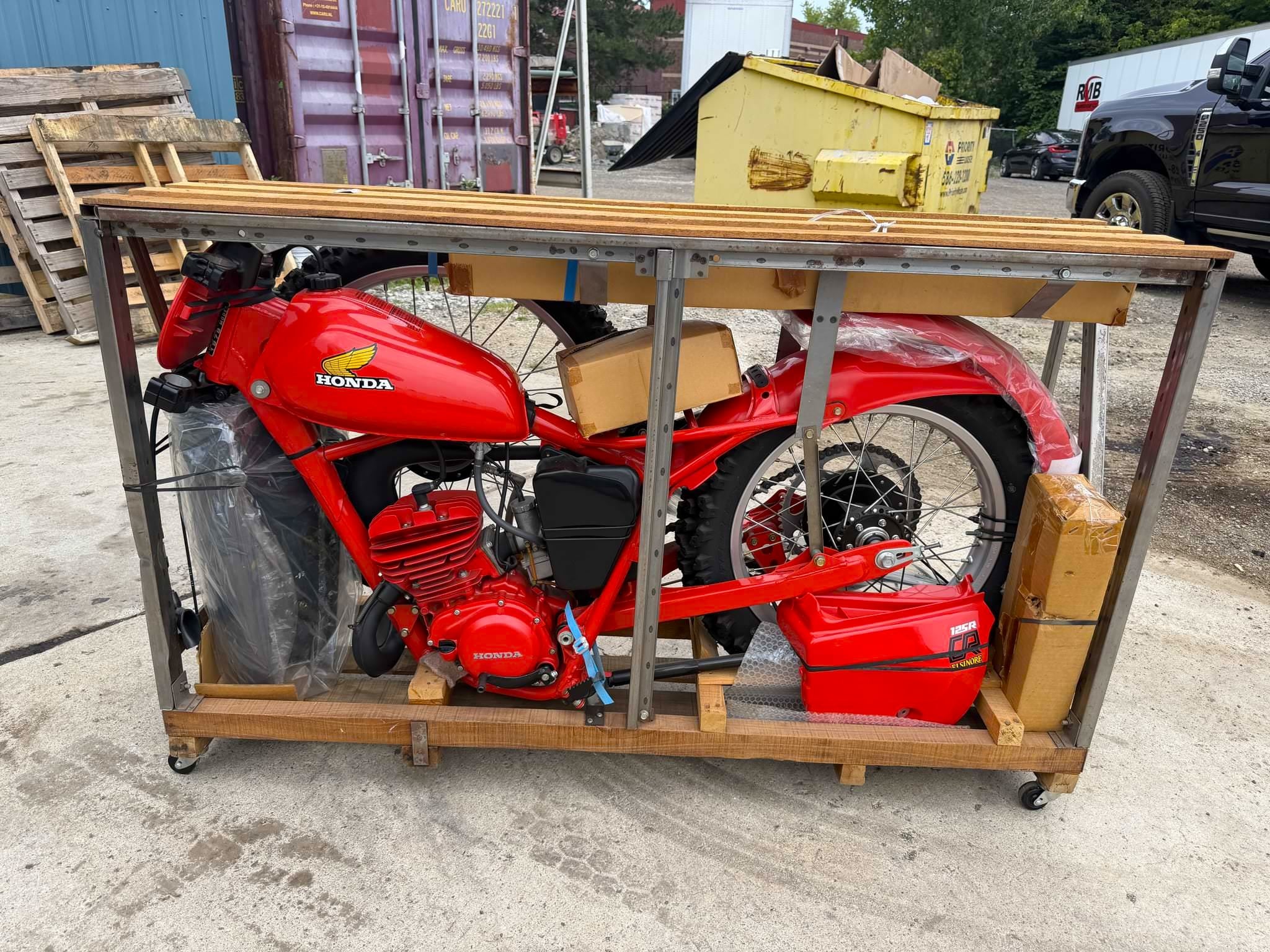
This is a 1979 Honda CR125R Elsinore, it’s been sitting unused in its original factory crate since 1979, and it’s now possibly the only unridden example of its kind left in the world.
📌 The Core Development
Honda’s Elsinore series of motorcycles from the 1970s (and very early 80s) are now legendary in the vintage motocross community, they were named after the Southern Californian Elsinore Grand Prix, and they became a force to be reckoned with in their time.
Honda sold its 125cc motocrosser under the Elsinore name for a total of eight model years, from the air-cooled 1974 CR125M to the liquid-cooled 1981 CR125R. The first one came from a company whose founder, Soichiro Honda, had famously said in the late 1960s that Honda would never build a two-stroke motorcycle.
🔍 Background & Sector Context
Honda signed rider Marty Smith, who was then just 17 and still in high school, for the inaugural AMA 125cc National Championship in 1974 and gave him the RC125, the factory version of the CR125M. Smith won the first two rounds and finished second in the other two to take the title, with Honda riders filling the top four places. Images courtesy of Honda.
A group of younger Honda engineers was building a two-stroke anyway, as a secret project without the knowledge or approval of Honda management. Their 250cc prototype first raced, in disguise, in August of 1971, and a 125 followed it onto Japanese motocross tracks in July of 1972. Honda ran the smaller 125 model in the All-Japan Motocross Championship while it finished development, then announced the production CR125M at the start of 1973.
📊 Industry & Real-World Impact
The name came from the Elsinore Grand Prix, an early-summer cross-country race in California that had appeared in the 1971 film On Any Sunday . In the United States the 125 arrived a few months after the CR250M, with a 1974 model-year designation, and an MSRP of $749 USD. In May of 1973 Honda added the MT125 Elsinore in Japan, a dual-purpose model which was based on the CR125M, but with lights and other road equipment to ensure it would be street legal.
Benchmark Telemetry & EV Fuel Savings
Put top supercars and EVs to the test in The Pit Stop Lab — launch head-to-head 1/4-mile drag strip battles & compute EPA electric fuel cost savings.
⚡ Prefer Visual Stories on Mobile?
Experience this news piece in an interactive 5-slide visual format crafted for mobile devices & Google Discover.
🔮 Strategic Outlook & What Lies Ahead
The engine was a 123cc piston-port single with a 56 mm bore and 50 mm stroke, a 28 mm Keihin carburetor, a capacitor-discharge ignition (CDI) and a 6-speed gearbox. Honda claimed at least 21.7 bhp at 9,500 rpm and 12.3 lb ft at 9,250 rpm – not a bad horsepower number for a 125.
The bike was fitted with a 21 inch front and 18 inch rear wheel on a 53.5-inch (1,360 mm) wheelbase, with 31 mm fork tubes, conventionally mounted twin rear shocks and drum brakes front and back. Its quoted weight of 179 lbs (81 kgs) was close to the FIM’s 176 lb minimum.